How it works
A review workflow, not a chatbot.
Every step keeps a person in control and every answer attached to its source.
01
Collect evidence
Upload supplier declarations of conformity, certificates and test reports as PDF or XLSX. Files go straight to private EU storage, and every upload is hash-verified.
Each document is read with its exact page and character, or sheet and cell, positions kept. Scans without a text layer are rejected rather than silently “processed”.
02
Approve claims
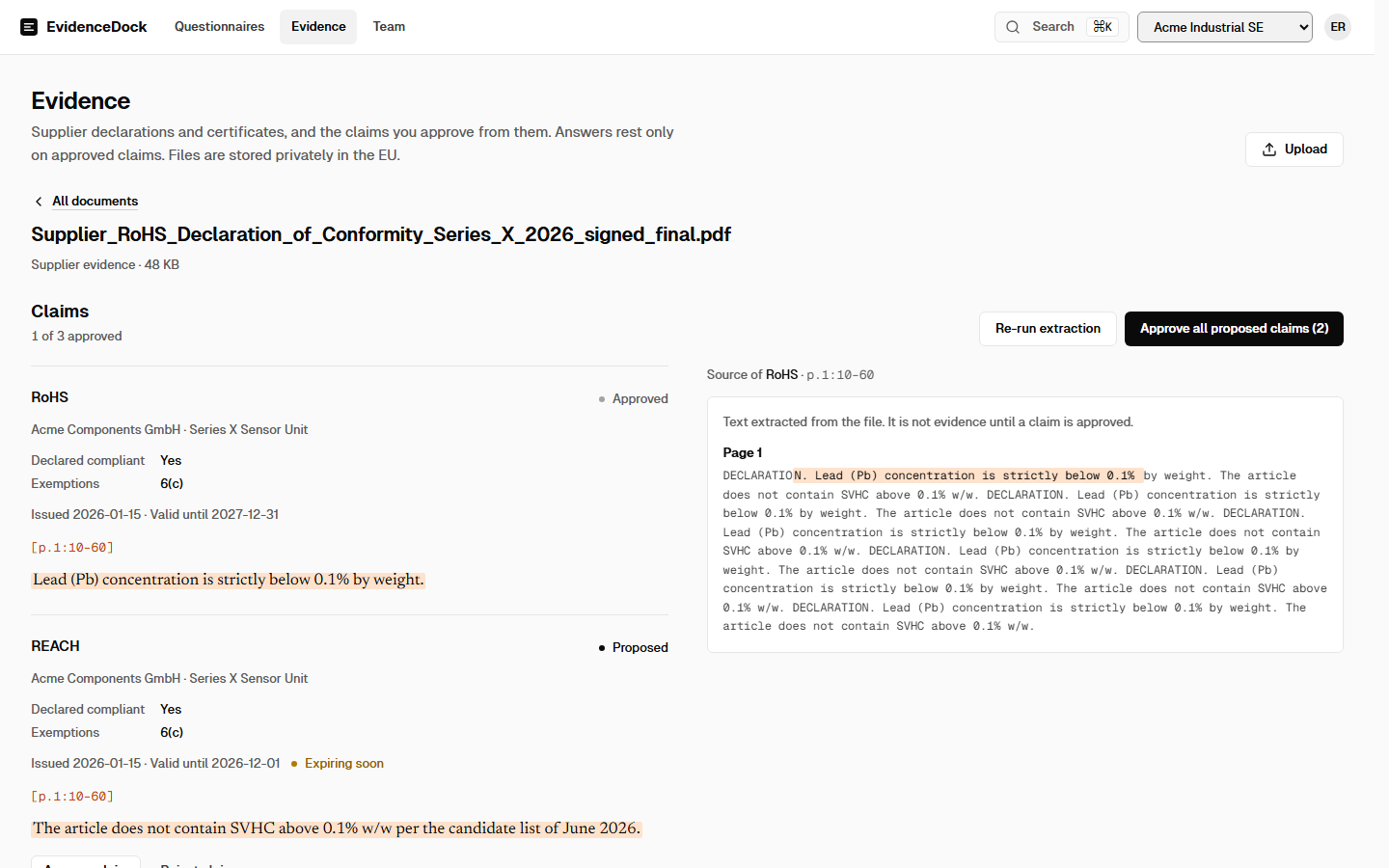
EvidenceDock proposes claims (topic, value, dates, supplier and product) each bound to the exact passage it came from.
You approve or reject each claim against its source. A deterministic check rejects claims whose quoted passage does not match the document exactly, so an invented citation can never become evidence.
03
Answer the questionnaire
Upload the customer's questionnaire (XLSX). Questions are read with their original sheet, cell and section.
For each question, EvidenceDock finds approved evidence on the same topic and for the same product or supplier, drafts an answer only from it, and checks that every statement is backed. Missing evidence and contradictions become explicit states, never guesses.
04
Review and export
Reviewers see the draft beside the exact evidence with the passage highlighted. Approve, edit, or reject; a note is always required.
Approved answers are written back into the original workbook, with structure, styling, formulas and other sheets kept, and downloaded through a short-lived link.
Boundaries
What EvidenceDock is not.
Not a chatbot
It does not answer from general knowledge. No approved evidence means no answer.
Not a PLM or supplier portal
It does not replace your product data or collect declarations from suppliers. It answers from what you already hold.
Not regulatory advice
It does not interpret regulations for you. It shows what your evidence says, and where.
Not autonomous
Nothing is sent or exported without a named person approving it.
No evidence, no answer.
The system may propose, retrieve and draft. It never turns model output into business truth: every answer that matters needs an explicit, recorded human approval.